Showing posts with label Earth Things Living Things. Show all posts

Tuesday, August 13, 2013

Gettysburg...reenactment of an horrendous Civil War Battle:Gettysburg, July 1-3, 1863 Introduction..more to come.

The "High Water Mark" signified the end of the devasting Pickett's Charge
Reenactment of the final event called Pickett's Charge
____________________________________
 To see even in reeactment the horrendous slaughter in the infamous Pickett's Charge
was heart rending. Overall, the reenactment can bring the spirit closer to 
those events of July, 1863.  It was for us an educational and emotional, heart
tugging event...because 150 years ago it all was real and men were
 becoming calualties in huge numbers. Actually, perhaps
 not so ill planned as some believe, many factors
 contributed to the defeat of
 Lee's army in the battle.


It is estimated between 46,000 and 53,000 were casualties at the Battle of Gettysburg.  Played out on the farmland and low hills surrounding Gettysburg, Pennsylvania, the actual battle could not possibly be replayed for the sake of history on those hallowed grounds.  The actual battlefield areas provide a memorable driving tour with many markers in memory of soldiers from several states.  During the reenactment dates is not a good time to tour the battlefield simply because it is too, too crowded and parking at the visitors center is best skipped and a shuttle taken from town.  A few days after the reenactment, parking is easy.
Gettysburg, reenactment of battle of 1863, cannon being fired.
The large fields provided better scale to the Gettysburg 150th reenactment.
If not on the battlefield, where is the reenactment done?  Local farms have provided the land, room enough for several thousand reenactors, somewhere betweeen 12,000 and 16,000 are numbers posted here and there.  A definite number will be found and this blog post revised as need be for accuracy. We stayed from Tuesday through Monday morning, July 2-8.   The reenactment played out July 4-7, one day added so an additional battle could be played out with the climatic conclusion of the long and devestating Confederate charge now known as Pickett's Charge.  


gettysburg 2013, reenactors fire Civil War cannon
 We counted over 100 cannon at the  Gettysburg battle event
As more time is given to writing and editing of a multitude of photographs, this post will expand and will eventually become a page so all will be kept in order, not the last to first pattern of blog posts. (A blog page is an article with a permanent link just below the header of the blog site. You will see tabs for pages at the top.)

The days were quite hot and all ended as it did in 1863...the rains came down right after the last shot.

More to come...check back.  Comments appreciated. Guest blogger will be considered.

Monday, May 28, 2012

Amicalola Falls State Park, Snakes, Moonshine Whisky and Appalachian Trail

This post is about two short hikes in Amicalola Falls State Park and the interesting critters and objects seen along the way. One interesting object spotted in the woods is said to be a remnant of the moonshine business in the north Georgia mountains. Photos of that are at the end of the post. Amicalola Falls State Park is near the southern start of the Appalachian Trail in the state of Georgia, USA.

The AT (as hikers call it) is the 2,184 mile trail mostly through wilderness areas of the Appalachian Mountain System from Springer Mountain, Georgia to Mount Katahdin, Maine. Springer Mountain and the southern end of the AT is just outside the state park. The Wiki link below goes to a sketch of the Appalachians on a map of the United States and the second link shows the Appalachian Trail as a line along the mountains. At the bottom end of the trail line is Springer Mountain. Go 8.1 miles (13km) south and you will be at Amicalola Falls, the ending point of the two hikes combined in this post.

Appalachian Mountains System
Appalachian Trail, Wiki

Amicalola Falls, top two thirds


Top of waterfall as seen from vantage
point of the previous photograph

While every trail in these mountains has a particular character, much is seen in common where altitudes and general weather conditions are close to the same. Hikers moving northward into the Smoky Mountains of Tennessee and North Carolina would notice the higher altitudes bring different conditions and other forms of plant and animal life. While mostly deciduous trees such as Tulip Poplar fill the area around Amicalola Falls, the higher Smoky Mountains graduate into evergreens and mountain laurel shaded streams. Going to lower altitudes the evergreens are again replaced with hardwood deciduous trees.

This post does not venture north of Amicalola Falls but does provide a lot to see without going deeply into the woods.

 Steps were constructed fairly recently from the falls top to the level shown in first photograph, 426 steps down and slightly over 200 more to the fall base.
Warming up is recommended prior to going up.

The hike into Amicalola Falls at the level shown is more of a short walk than a hike. Approximately 0.3 mile long, the trail gently descends and is paved with recycled rubber from tires.  This very gentle pathway makes the falls accessible to most everyone. Still, the woods surrounding the walkway is the same woods found on the moderate and strenuous trails and will allow you to see many of the same features if you look around at the large and small provisions of nature.  We had seen the falls and did enjoy that. We went up the steps to the top and back down again. On the walk out other visitors stepped quickly passed us as we looked for surprises and found a few.


 Can you identify this egg case?


The most damp part of the trail edge revealed a lot of snails almost hidden in the foliage. A granddaddy long legs walked across
this snail and stopped to "take a drink" from the wet back of the snail's head.  At least, it appeared to take a drink...


Its web under an outcrop at the woods edge, this spider has a tunnel web.  It would sit in the doorway and wait for insects to be caught in the web away from the tunnel.

The Appalachian Approach Trail begins at the park visitor center then to the base of the falls.  At the onset and along this trail we saw the snakes.  Following the trail on and upward past the falls is the trail to Springer Mountain and the official southern end of the Appalachian Trail.  Those hiking the AT would generally begin at the trail access above the waterfall.  We took the trail toward the base. 

The trail passed a developed pond where visitors fished for trout.
Sunning on the pond edge was this stout water snake. Keep in mind, killing snakes or capturing for pets is illegal in most states. Georgia imposes a $1000 fine for killing snakes.


Copperhead! It is amazing how seeing a snake in the wild and only getting a partial view will lead to a mistaken identification.  This was on the trail edge in downed trees and bramble  We could not see its head clearly at the time. The back pattern should have been enough to tell us it was not a copperhead.

Copperhead and timber rattler are the two venomous snakes in northern Georgia. This snake was neither. The pattern on the back is that of a water snake. The darker markings are the opposite of the copperhead: Copperhead  darker markings become narrow along the back and not wide as in this snake. It took seeing this photo to know what we had really seen. The head appeared clearly only for a split second and we did not see it neatly while on the trail.  Still, the practice is not to approach the snake or ever reach for it, even if you think you know what it is. Thinking back, we were fairly close to water at the time.  Who knows, I believe it to be a water snake but may yet be wrong. I do know it is not a copperhead.

All in all, Amicalola State Park in northern Georgia makes for a fun and  pleasing long weekend. This is not a large park with trail after trail after trail. It does offer trails enough for the weekender and is quite pretty and resting to the eyes and spirit.  

 From our accommodations in the park lodge, this is an evening view of foggy clouds coming over the mountains nearby.  
_________________________
___________

The Secret seen by those who take the time to look into the woods, something most folks did not do and simply missed seeing...


Those familiar with old time history of moonshine know the mountains of North Carolina, Kentucky, Tennessee and Georgia were home to a few inventive folks who made white lightning.  This illegal "whisky" was almost pure alcohol.  How did it get to town? Sometimes the transportation was tanker trucks or cars, ordinary vehicles with hidden tanks or storage areas to carry the moonshine.

Most of us have heard of moonshiners in souped up cars running from the law. As I was told by the locals, this truck we spied in the woods was a tanker truck.  To be where it was meant a long drop..a crunching roll down several hundred feet of very steep mountain side.  The photos do not do justice to the steep grade of the mountain.  The road runs on up to above the falls but at this point we were on a trail below the falls.  What happened really? Was anyone in the truck when it tumbled down the mountain? No one knew the full story but all said it was a moonshiner's tanker.

Notice in this closer view how the poplar tree has grown 
around the front of the truck.  That is the hood against the tree
and the smashed remains of the roof bent down and onto the hood.

The end of this post


Tuesday, November 8, 2011

Fallen Hostas, Fall is Leaving Us,,,

When winter approaches, the leaves lean closer to the earth each day. When all are hugging the earth around them, the color becomes a lovely yellow, a color hidden all summer and now a joyful way to end a summer and say goodbye for the season.

 Hostas, a natural greeting to winter and good bye to autumn
Joyful, joyful for each season...and to live where each  has its own distinctive vision and touch to our skin...that is good. Winter is coming.

Thursday, October 27, 2011

Fossils at Gray, Tennessee Discovered By Road Crew in 2000

MORE SPECIES ARE REVEALED IN FOSSILS FROM THE LATE MIOCENE EPOCH AS DIGGING CONTINUES

Follow the Photographs to Learn Part of the
                                Gray Fossil Site Story.
It started in year 2000 when a crew was working to improve the road and came upon soil that seemed out of place. In the soil were found fragments of bones and plant remains. Fortunately, East Tennessee State University was nearby and with the fossil site confirmed, a new university department was developed and the laboratory was the Miocene fossil dig near the town of Gray. Students at the university now have hands-on experience in the recovery, identification and preservation of prehistoric remains. Like a dream come true, a new professor soon had his own department at the University, along with museum and on-site facilities.  This appears a win-win for paleontology (and associated sciences) as well as for the university, students, perhaps for a local farm and for those state government people assigned to promoting tourism in the state of Tennessee.
Shown under construction 1 year ago, the educational and visitor annex to the East Tennessee State University and General Shale Brick Natural History Museum  is now open. Paleontology is fascinating to school children and the annex is provided with a classroom to accommodate 100.
The fossil site is a prime location for school field trips 
and is a hands-on laboratory for ETSU students.

For us other folks, the Gray Fossil Museum at the site is easy to get to off I-81 in Tennessee. Type “Gray Fossil Site, Suncrest Drive, Gray, TN” into an Internet map provider site such as Google Maps, get directions and visit if you are in the area. We did that in 2010 and totally enjoyed seeing the actual digging areas and the assembled critters on display.  Since it was late fall, student work was suspended until the coming spring.


The Miocene Epoch is said to cover time from 23.8 to 5.3 million years ago. The Gray Fossil Site is said to be from the late part of that epoch, only 7 to 5.3 million years ago. Yikes, that is recent!


Bones found are not turned to rock as commonly thought in fossils. These are actual bones and must be carefully preserved. Using what is apparently cold molding compounds, molds are made of the relics and then copies are cast in the molds. The original bones are much too fragile and valuable to be assembled into a mock-up of a prehistoric animal, therefore the castings are used for this purpose. Great care is required to make the fossil bone castings as close to the appearance of original bones as possible.


Links below tell much more about the find than I do here on the blog. There are no dinosaurs in the find because it is much too young in prehistoric years. The animals are types of ancient camels, rhinos, bears, tapirs, sloths, turtles, lizards and others. There are even prehistoric panda bones including the skull.

The original hole is in the rear with the unusual dark soil showing. At middle right is a test hole.


Shown full of water run-off, this is a productive pit. A prehistoric Rhinoceros was found here. When weather allows continued digging, who knows what prehistoric creature may be found.

Skull and jawbone of prehistoric Bristol Panda found at the Gray fossil site
with modern bones for comparison


This information below is quoted directly from the “Educator’s Guide” which may be downloaded from the Gray Fossil Site website at the link shown:  “The Tennessee Department of Transportation (TDOT) discovered the Gray Fossil Site in May 2000 during routine road construction. Workers uncovered a deposit of soft black clay that is not typically seen in our region. They found that the black clay was not suitable for road construction so they called in TDOT geologists for technical advice.
The geologists examined the black clay deposit and found a large number of animal bones and plant remains. They also discovered that the deposit was layered in the same manner as pond or lakebed sediments. These lacustrine (or lake formed) sediments accumulate in slack or still water from silt that sinks to the bottom of the body of water. Leaves and twigs also sink to the bottom adding to the organic ooze. This ooze provides an excellent environment for the preservation and fossilization of plant and animal remains….”
http://www.grayfossilmuseum.com/?BISKIT=3085743966&CONTEXT=cat&cat=102


The man in the middle left is working on assembly of parts of a tortoise or turtle shell found broken and partially crushed.  Can you imagine the precise work needed to do this job and the patience required by the student worker?


This is a cast replica of a Rhino skull. You will see assembled skeleton forms of several types of animals at the museum. The white containers are safe storage for the many fossil remains  found in the black clay at the dig.

A GOOD WIKI ARTICLE ON THE GRAY FOSSIL SITE:
http://en.wikipedia.org/wiki/Gray_Fossil_Site

The photographs  in the blog post are from a visit in November 2010.  I wonder how the same places look now, one year later?

As we left, there in a field next to the Museum boundary was a home made sign. It said something like The Fulkerson Farm  Fossil Site. .
In September of 2011, a press announcement stated that acreage was purchased from the Fulkerson Farm by the Museum to allow fulfillment of coming development.
Link to the press article with photos:  http://www.johnsoncitypress.com/Living/article.php?id=94254


This view is beside and looking beyond the fossil site toward farmland in the distance. Dirt first excavated for the road project was put here and all will eventually be sifted and examined for the tiniest fossil relics. The yellow bags in the left are full of soil awaiting further examination.
--------------------------

Thomas Haynes is a photographer working out of Clinton, Tennessee, a city just north of Knoxville. His photography is often of a fine arts direction but as in this post, his love of nature takes him again to the Clinch River Raptor Center, a rehabilitation and educational not-for-profit organization.. Visit Thomas and see more of his photography at  Facebook

 Contact Thomas to discuss photography you want done. 

_______________________________________

Friday, September 16, 2011

RESCUED AND ADOPTED CATS NEW LIFE HISTORIES

NEW PAGES WILL TELL OF CATS ADOPTED AND RESCUED. The cats came from shelters or "showed up" living on their own in neighborhoods having been dumped or after escape from cruelty.  These animals have lived in a good home for several years since rescue and each has a story to tell. 
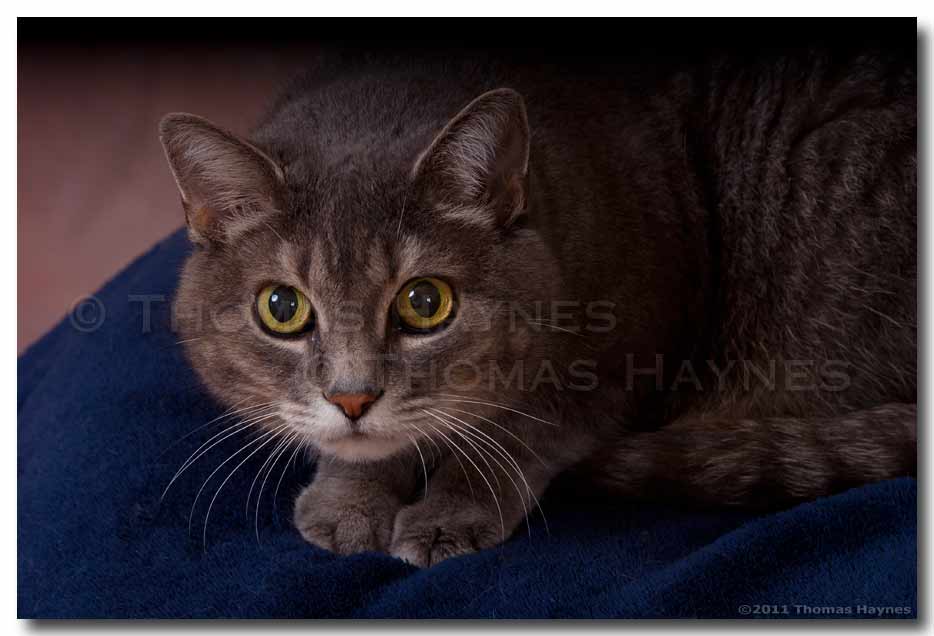
Molly is a gray blue cat with very soft fur...adopted 3 years ago after being lost or thrown out.
 Click for a larger view.

Many people make good caretakers for pets. Unfortunately, many who take in pets, whether dogs, cats or other animals simply do not provide the care the animals need.  The animal may have a home but later die because proper  medical attention was not considered needed for an "animal" or the owners were not willing or able to pay for medical care. Females of both cats and dogs are often adopted then become pregnant because the owner cannot afford to spay the animal or simply refuses to pay for spaying.  The female may then be dumped, taken to the shelter or worse.  Babies are given away with little thought of the home awaiting them or are taken to shelters. In a worse case, babies are killed because they are not wanted and the mother is blamed for becoming pregnant.

WILL YOU BE A GOOD PET OWNER/CARETAKER?   Read the short stories of the cats in upcoming pages and ask if you would be as willing to provide for the animals.  Animals bred for pets do not survive well in the wild, regardless of the misconceptions of them being wild animals and capable in wild settings. A feral cat or dog will survive only a few short years and a domestic one dumped into the wild will die in a relatively short time of starvation, predation or disease.

I HOPE YOU ARE OR WILL BE A RESPONSIBLE PET CARETAKER. The situation is one of sharing and those who love domesticated animals will readily tell how much the animal provides in joy, comfort, companionship and simple fun. As this article is continued, short stories of particular rescued animals will be told, simple stories you may find very well worth reading. 

Look for new stories on the tabs in the header of this web page. 
 The stories will tell of funny things, strange events and health issues faced and taken on.  Happy stories are best and most of the upcoming stories will be happy ones.  I will tell of ghostly cats and a cat who was a genius in geometric designs. You will also read of hydration for cats with kidney failure and radio iodine treatment for cats with overactive thyroid glands.  You will also learn how the very, very biggest was the most gentle and quiet of all..with heart of love.

The stories will be published as pages, a method used in blogs to tell continuing and connected articles.  To publish as daily posts always puts the most recent story at the top. That is good for daily postings but for a continued article everything is backwards, last to first. So, to keep it in order, tabs will be in the page header for the cat stories so you may easily choose which to read.

I may solicit your story?  Do you want to tell readers about your rescued pet? Email that to me and I will get back with you about using it. I am still thinking how this might work out. If you want, I can edit and rewrite your story for you. Stories will need to be no longer than the post you are now reading. (My MS Word says this is about 600 words. Do not worry about the exact length but please try to stay close.)

Now, I am off to do other business and hope you will find the upcoming pages on rescued animals to be worth reading and passing on to others.        Sincerely,   Thomas Haynes..

Monday, August 22, 2011

Vultures are Vultures...Vultures are not Buzzards...

"Look at all those buzzards!  There must be a hundred of them up there."  There could very well be a hundred vultures going from horizon to horizon, seeming to glide the full path without a wing beat. To get technical, they are not buzzards except by adapted local language usage.  The term "buzzard" is used in the UK to describe soaring hawks and not vultures.  Like it or not, the Brits are right on this one!  Still, after years of associating the word buzzard with vultures I do not call any hawks "buzzards" and likely never will.  Buzzard does not sound dignified enough for hawks, not to me.   In fact, after being around vultures for a while, I don't call them buzzards, either.

                                                             A Young Black Vulture
My name used as a watermark is added to all on-line photos to help prevent ripping of © material. Sorry it must be that way..

An American definition of buzzard will include the turkey buzzard as a alternative meaning. The term is well accepted in parts of North America, so well accepted that if you should call a soaring hawk a buzzard you will likely be corrected: "Bud, that's a chicken hawk. It sure isn't any buzzard."    Truth again is there is not a hawk named "chicken hawk" but folks love to call any hawk a chicken hawk.  Perhaps the bird hunting Cooper's Hawk is how chicken hawk came to be applied to hawks.  A man I know grew up in Brooklyn, New York City...he spoke of chicken hawks and squirrel hawks. He could take me on a tour of New York City (I would be lost otherwise) but that tour would reveal no squirrel hawks.

As this post is continued, a pint sized box of knowledge about vultures will be opened.  What I know of these neat big birds is a small plate but is truth, solid honest stuff about vultures. For instance, a vulture will prefer a  fresh meal to a road side pancake.  A meal recently placed on the table beats one left there for days and even vultures have a sense of  preference in that.  Vultures are bald headed...true of adults. The young black vulture in the photo has a full feathered "hair line".  As this bird matures, the head will become grayish  white and featherless. Why is that do you think?  This vulture was rescued and eventually went to live in a vulture center with others of its kind unable to live in the wild. (Yes, there are licensed homes for rescued vultures.)
                                 Vultures...are not buzzards will be continued...

The Girl Went For the Vulture.  The Guy in Sunglasses Had Nothing To Say
...a very short and true vulture story

When that turkey vulture came over the second time and this stranger, a man old enough to be her father spoke of vultures, she turned to the stranger then searched the sky for the vultures again. "I had no idea," she said.  A silence covered that place as nature had her time, captivating each of us watching as the vulture became only a dot in the sky then vanished. 

The young lady went back talking with the guy in the sunglasses.  We hiked back to the road and looked for other trails above the gorge.

What had been said that so caught the girl's attention?  I told her we were moving too quickly for a turkey vulture to be interested. When looking for dinner, they choose the slowest possible moving things...dead is slow enough. And if disturbed, they will throw up.   Vultures will throw up and you do not want to be there.  Eating dead things preferably fresh but not always, a vulture must have an incredible defense against infection. Part of that defense is a quite high acidity in the digestive tract.  The expelled material will not only smell terrible but  can irritate the skin from the acid content.  Of course, at the rehab center caretakers clean up the material without touching it.  This is a part of vulture life, eating and throwing up more often than we would after dinner.

Notes about the vultures shown: The young vulture at the top is a Black Vulture and will have a grayish white head as an adult. The adult in the lower photo is a Turkey Vulture and has a red head and face. The wings are marked differently and the tails are shaped differently in these two breeds. 
Here is a link to follow.  Cornell, Black Vulture


Wednesday, July 20, 2011

IS IT WRONG TO KEEP A WILD ANIMAL


WILD CORN SNAKE PET, WILD TOAD PET, BABY OWL,  RACCOON, BOX TURTLE...the list goes on and on. People like to try and make pets of wild creatures and generally the loser is the wild creature.

Depending on where you live,  you might be breaking the law!  Wild Creatures are not made to be pets and to do so is illegal, illegal, illegal in many places. You must be properly licensed to keep wild animals and that means you are trained to provide proper care and have a valid reason beyond your personal entertainment and desire to have a wild animal pet. 

Are you a kid with a wild thing, like tadpoles turning into frogs in a little aquarium?  I have not written this post to frighten you.  Please have your parents read the post and talk about it. That is fair, don't you think?  Talk about what is the best thing to do now.

This toad came by for a visit on a rainy day, sitting in the gutter drain.

Quoted from the Tennessee Wildlife Resources Agency Website:


“My child wants to make a pet of a box turtle (or any wild animal) we found in the woods. How do I care for it?"


"In Tennessee, no one is allowed to keep any animal as a pet taken from the wild, which to many people's surprise includes tadpoles, frogs, lizards, snakes, turtles, baby birds, squirrels, raccoons, and young deer. If the animal is injured, call the nearest of TWRA's four Regional Offices for a list of permitted rehabilitators, who will keep the animal until it can be returned to the wild. If it cannot be returned, the rehabilitator will turn the animal over to someone with a special Educator's Permit, who may be able to use the animal in a classroom or teaching setting.”

http://www.state.tn.us/twra/faqmain.html#Wildlife

___________________________________________

The Wildlife Regulations should be checked for where you live. However, wisdom says to leave the wild critters alone in their environment.  Take to a rehabilitator if circumstances are critical.


Sure, that little owl fallen from the nest is cute, responsive and you would love to keep it. Please don’t do that! Only properly trained and licensed people should care for wild animals. Wild animals are part of the natural cycles around us and are not intended to be a child’s “nature pet”. In fact, taking an animal from the wild is about the worst thing you can do for the animal.  Will you be able to give it the wild life it is born to live?  Once a baby animal sees you as its "mom", it is imprinted on you. As far as I know,  only animals which are raised by a mother/father like furry animals and birds will imprint.  It will not have the natural associations with others of its own kind and would die if released into the wild without the recognition and skills needed to hunt and eat, to meet and get along or avoid others of its kind and to avoid the greatest predator which is people.

 
Call your wildlife agency and/or  veterinarians and keep calling or checking the net to find an animal rehab facility. That is where you can find out what to do. With wild snakes, turtles, toads, and other critters which are not injured and are old enough to care for their own needs, simply turn them loose in a proper place not far from where you found them.

A PET WATER SNAKE TAUGHT ME WHY

The brown water snake was caught in a small stream about 2 miles from my childhood home. It seemed ok to keep it in a small glass enclosure to show to friends and take out once in a while to be in the sun in my hands.  I got bit once in a while but it was not poisionous and the bite was not so bad.  I gave it a bowl of water, some bugs and a tadpole but that in no way took the place of its original stream and all the food for it there.

One day I went outside with the snake to let it sun. Being a kid, I got distracted for a moment then noticed the snake was gone! Oh no!  I searched everywhere and could not find the snake.  Two days later while walking around the neighborhood about a quarter mile from my home, I found my water snake.  It was on the curb and dead. A car had run over it.  Where was the snake? It was in a direct line from where I lost it to its home in the stream.  Going home?  That is what I believe and I learned the lesson to leave the wild critters in their home. I was the kid who had a snake pet and the snake died because I took it from its natural home. Now, when I see a water snake I will watch it or try to get a photo but I leave it alone to live the life intended.


Thursday, May 26, 2011

Follow Me...Stand Here and Look. Beyond the Stone Pillars


PHOTOS IN THE "FAVORITES" FILE OF MY MEMORIES…that is what this post is all about.  I will try to  add a different image every day or two for a few days more.  I am sure you recognize this place.  Stonehenge is a place we want to see again. We want to see all of the UK again, more closely and standing in a place to look beyond the common view.

                                                                                                          click for larger

Where is the famous circle of stone pillars?  Oh, it is here, just to the left.  We are standing in a large and beautiful open place, close to the ancient and more vast than a circle of stone. To the left is a reminder of life many, many years ago while behind us and far beyond is life today.  Stonehenge is more than a circle of stone. Sure, we have photos showing all of Stonehenge. The photo above is not the usual view and is for that reason a favorite.
added on May 27...

BIRDS ON ANCIENT STONES, BIRDS ON SHEEP AT STONEHENGE 


Here are other views from Stonehenge...coming next post is an entirely different subject and after that back to the last educational bird from the Clinch River Raptor Center.